Thursday, 27 July 2017
745 The Beginner's Guide To Absolute Beginners
First viewed : 29 March 1986
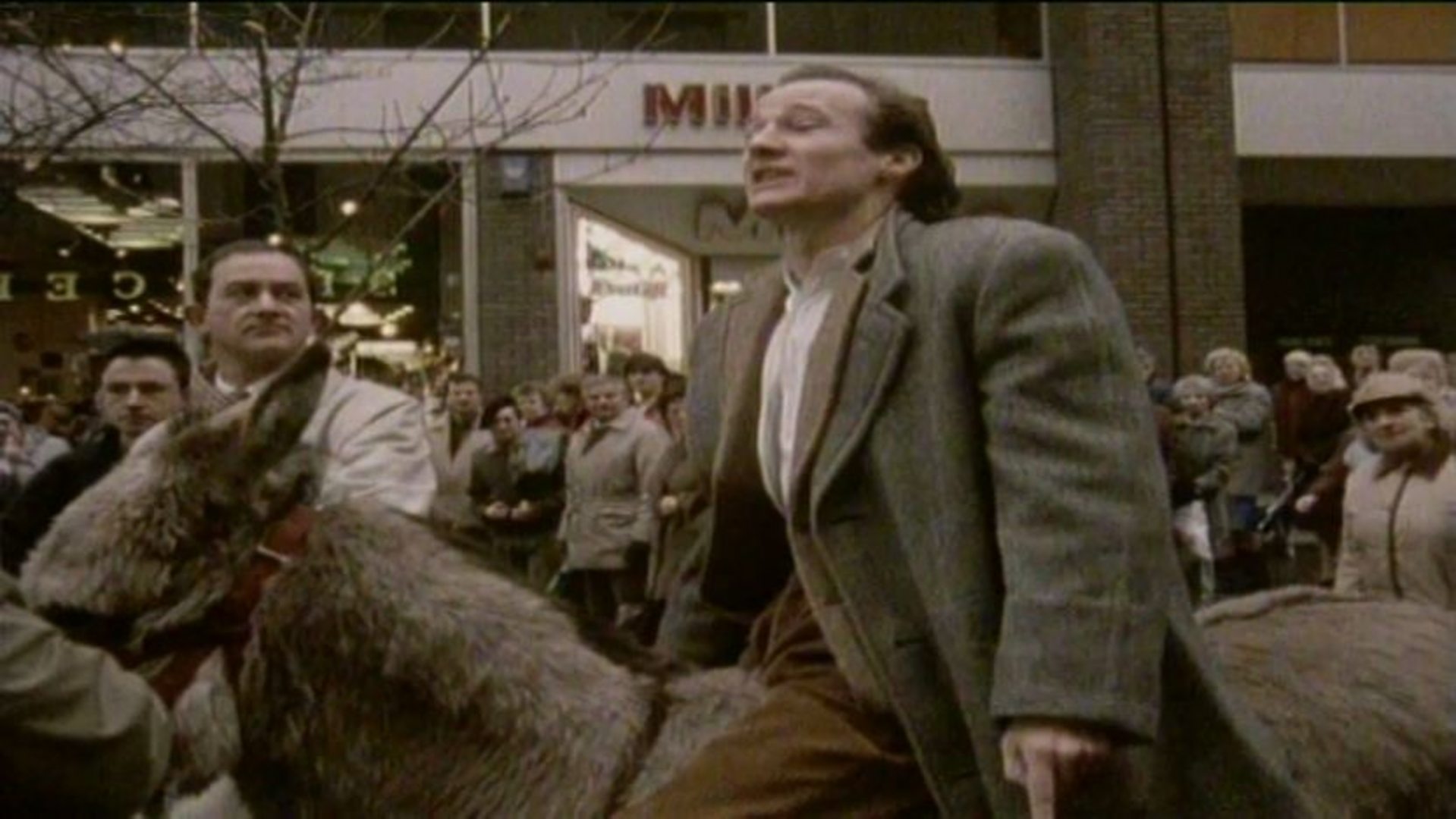
Oh yes, you couldn't get away from the desperate hype surrounding the release of this film. Its makers, Goldcrest Films, had been hit for six by the box office disaster that was Revolution and the whole future of the British film industry was seen to rest on the success of Julian Temple's musical version of the Colin McInnes novel of teenage London in the late fifties much loved by the mods ( hence The Jam's 1981 hit of the same name ). The media obligingly gave it saturation coverage including this short documentary on ITV.
Unsurprisingly, the film failed to live up to expectations. Much of the music was anachronistic, an eighties version of what fifties jazz was like from Sade and The Style Council, in other words the film was promoting the new jazz / anti-rock movement which had already passed its peak by 1986. It was also too London-centric , finding parts for the likes of Ray Davies and Mandy Rice-Davies and giving the main female role to a far too young Patsy Kensit. The male lead was unknown Eddie O Connell who couldn't carry the film.
Temple fled to America and Goldcrest went belly up but then the little-hyped Mona Lisa came along and the industry wasn't so dead after all.
Wednesday, 26 July 2017
744 The Holy City

First viewed : 28 March 1986
This was a one-off drama for Good Friday which set the story of Christ's Passion in contemporary Glasgow. David Hayman played the Christ figure as some kind of left wing street preacher. I remember my sister seeing a trailer and saying "That looks awful". I caught a small part of it showing Hayman stopping a man beating up his girlfriend by saying "Gae on if ye've never done it yourself".
The play is also notable for one of the last screen appearances of Fulton McKay who died the following year.
It has never been repeated and has a very meagre entry on imdb.
Sunday, 23 July 2017
743 British Cinema : A Personal View
First viewed : 19 March 1986
As part of British Film Year ( which was actually 1985 ) ITV commissioned three notable British directors to make an hour's documentary film giving their thoughts on the industry.
I only saw the middle one. Sandwiched between Alan Parker and Richard Attenborough was Lindsay Anderson , director of This Sporting Life and If.
Anderson was incensed by a comment from David Puttnam that the British film industry was now essentially an adjunct to Hollywood and judged that the best counter-argument would be an account of his own career as a pioneer of the Free Cinema movement in the fifties and beyond. As an example of making yourself the hero of your story it would be hard to beat . Nevertheless it was an interesting tale and Anderson was a good raconteur. He concluded by offering his 1982 political satire Britannia Hospital as the apogee of his art, not an assessment many would agree with.
Saturday, 22 July 2017
742 Halley's Comet : The Encounter
First viewed : 13 March 1986
One afternoon, in the academic year 1973-74, several of my class mates claimed to have seen a comet flying past the school window. By the time I got there, it had gone. I know now that whatever they saw , it certainly wasn't a comet and, as it was still daylight, it was unlikely to have been a meteorite either. Back then, I was gutted to have missed it and the sense of disappointment and determination to catch the next one lingered.
Therefore, I got very excited when the most famous comet of all , the one identified, by the astronomer whose name it bears, as a regular visitor to Earth every 74-79 years, came by once again in the autumn of 1985. After reading in the paper where to find it I went out on several nights , at least once accompanied by the infamous Pete, but we could see nothing. Of course, the light pollution from a city like Leeds is considerable but in fact, on this occasion, the comet was not visible to the naked eye from anywhere in the northern hemisphere so I missed out on my comet sighting again. I vowed to live until 96 in order to see it on its next visit. As both my parents died of strokes at the age of 71, that seems rather optimistic now.
However I did watch BBC One's live coverage of the comet's encounter with the Giotto space probe that was sent up to view it at close quarters a few months later. The pictures were computer-enhanced to make them a bit more comprehensible to the lay viewer. Frankly, it looked like an abstract school painting but Patrick Moore got very excited about it and that was good enough for me.
The happy ending here was provided by Comet Hale-Bop which I saw on a number of occasions in 1997 and happened to be in the sky when a certain event of personal significance took place. We'll leave it there I think.
Thursday, 20 July 2017
741 No Place Like Home
First viewed : March 1986
Like, I suspect, many people, my only exposure to this domestic sitcom was the 12 unendurable minutes between the end of Coronation Street on ITV and the start of Dallas on BBC 1 in the spring of 1986 when this was in its third series . That however was more than enough to earn my nomination as worst-ever sitcom.
The series was written by a Jon Watkins and concerned a middle aged couple, the Crabtrees ( William Gaunt from The Champions and Patricia Garwood ) whose four children decline to leave home. The eldest girl moves back in with aggravatingly gormless husband Raymond ( Daniel Hill ) in tow. To make matters infinitely worse they lived next door to the Bottings. Trevor ( Michael Sharvell-Martin ) was something of a soul-mate for Pa Crabtree but wife Vera was something else.
There was nothing wrong with Marcia Warren as the mother in Now and Then a few years earlier but, faced with a fairly unbelievable character in the childless animal lover Vera, she resorted to the most grotesque over-acting I've ever seen on British TV, beating even Christopher Rozycki in Casualty. Playing Vera as a demented perpetual student, she was absolutely unwatchable and her cast mates ( including a young Martin Clunes ) looked a bit embarrassed when she got going.
Clunes actually got out at the end of the third season and I suspect the producers realised they had to do something about Warren. Vera did not appear in the fourth season and when she re-surfaced in the fifth and final season in 1987 she was played by Anne Penfold.
Wednesday, 19 July 2017
740 Hammer House of Mystery and Suspense
First viewed : Winter 1986
This one brings back a few memories. Living back at home that term threw up some challenges. Towards the end of the previous year, I had been elected, at the third attempt , to serve on the Student Union Council which met fortnightly on a Monday. To ensure Councillors took their responsibilities seriously, there was a three strikes you're off attendance policy unless the Council accepted your request / explanation for absence. I was already a strike down for missing a meeting to attend an FA Cup replay where Dale beat Scunthorpe to earn a Third Round meeting with Manchester United. Apparently the vote was close and divided roughly on gender lines.
With something like 30 people at the meetings, they tended to drag on for hours and it was always a bit hairy whether they'd finish in time for me to catch the last train to Littleborough at 10.30 pm. With some avowed political foes in the room, I didn't like asking to leave early too often. By means of some desperate sprinting on occasion , I did manage to retain my place on the Council without being stranded .
I began to notice a young man who also got off that train at Littleborough although I'm not sure where he got on. He looked like one of the Farreys a family I knew from school although he wasn't the one I knew best. On one occasion he was clearly drunk and involved in a physical altercation with a guard. I mention it because a few months later, I caught an item on local news where police were appealing for information about the death of a Carl Farrey who had fallen from a Leeds -Manchester train. Putting two and two together, I went into the police station and told them about the incident I'd seen but it didn't seem to be relevant. I can't give any closure to the story; it's just one of those strange, sad coincidences.
Anyhow, after he'd melted into the night, I'd usually have time to pop into Lords' chip shop just before they closed and get a late supper. When I got in, this would usually be on.
The series was a follow-up to 1980's Hammer House of Horror with a similar number of spooky one-off dramas filmed in 1984. This time round, it was partly funded by 20th Century Fox which meant that nearly all of them had an American lead ( e.g. Dirk Benedict, Mary Crosby, Christina Raines ). Unlike the earlier series it was not nationally networked by ITV with different regions showing it at different times. I'm guessing this might have been because the films were 70 minutes long, an inconvenient length for British television. I don't know whether Granada had broadcast it before this appropriately graveyard slot on a Monday night.
I remember three of them reasonably clearly, none of them having a happy ending. In Last Video and Testament , David Langton from Upstairs Downstairs fakes his own death then leads his wife and her lover into a death trap before fulfilling his pledge to dance on her grave. In Black Carrion , an ageing rocker holds a village in his thrall after they mistakenly lynch his brother . In Czech Mate Susan George finds herself trapped behind the Iron Curtain after a defector steals her identity to make her escape.
Monday, 17 July 2017
739 Every Second Counts
First viewed : 8 February 1986
Every Second Counts was the new year replacement for Bob's Full House on Saturday evenings. As Dale were playing Preston North End away ( a 1-1 draw in PNE's worst-ever season ) there's no obvious reason why I wouldn't have seen the very first episode.
Like The Generation Game , the contestants played as couples ( three of them ) and played against each other in a number of general knowledge rounds earning seconds rather than points for a correct answer. When the rounds were completed, the couple with the most seconds took them into the second stage where, answering in turn , they had to complete four more rounds of escalating difficulty matched by an increase in the quality of the prize on offer, within the total number of seconds they had earned. The host was diminutive magician Paul Daniels.
I never liked it as much as Bob's Full House because Daniels was an irritant, never as funny as he thought he was but the quizzing itself was OK.
It ran until 1993.
Subscribe to:
Posts (Atom)